How Profitable Is Rabbit Farming in Africa?
Every few months, someone discovers rabbit farming as the “next big thing” in African agriculture, and the enthusiasm is understandable. Low startup costs, fast reproduction, minimal land requirements — on paper, it sounds like an easy win. But ask farmers who’ve actually been doing it for a few years, and you’ll get a more nuanced answer: yes, it can be genuinely profitable, but only if you treat it like a real business rather than a side hobby.
The gap between rabbit farming success stories and quiet failures usually comes down to a few predictable factors — market access, realistic cost planning, and patience during the early months when expenses outpace returns. This article breaks down the real numbers, the variables that affect profitability, and what separates farmers who make solid income from those who give up within the first year.
Table of Contents
- A Realistic Look at Rabbit Farming Profitability
- Startup Costs You Should Expect
- Ongoing Operating Costs
- Revenue Streams Beyond Meat
- The Breeding Math That Drives Profit
- A Sample Small-Scale Budget
- Factors That Make or Break Profitability
- Finding Reliable Markets
- When and How to Scale Up
- Common Mistakes That Hurt Profitability
- Frequently Asked Questions
- Final Thoughts
A Realistic Look at Rabbit Farming Profitability
Let’s start with the honest version: rabbit farming is profitable, but it’s rarely a get-rich-quick venture. Most successful farmers describe it as a slow build — modest returns in the first six to twelve months while the breeding herd grows, followed by accelerating profits once a stable cycle of breeding, weaning, and selling is established.
What makes rabbits attractive compared to other livestock is the speed of that build. A doe can produce 4–6 litters a year, each with 6–10 kits. Compare that to a cow producing a single calf annually, and the multiplication effect of rabbits becomes obvious. Within 12–18 months, a starting herd of just a handful of rabbits can realistically grow into 50–100+ animals, assuming reasonable mortality rates and consistent management.
Startup Costs You Should Expect
One of the biggest selling points of rabbit farming is its low barrier to entry compared to poultry, goats, or cattle. Still, “low cost” doesn’t mean “no cost,” and underestimating startup expenses is a common reason new farmers run into cash flow trouble early on.
- Breeding stock: A starter trio (one buck, two does) of a good meat breed typically costs a modest sum depending on region and breed quality.
- Housing: Basic hutches can be built relatively cheaply with local materials, though commercial-grade raised cage systems cost more upfront.
- Feed setup: Initial stock of pellets or forage, plus feeders and water systems.
- Basic equipment: Nesting boxes, water bottles or nipple drinkers, and simple record-keeping tools.
For a small backyard operation, total startup costs can be kept fairly low by using locally sourced materials for housing and starting with just a few breeding pairs rather than a large initial herd.
Ongoing Operating Costs
Feed is, by far, the largest recurring expense in rabbit farming, typically accounting for 60–70% of total operating costs. This is also where profitability margins are won or lost.
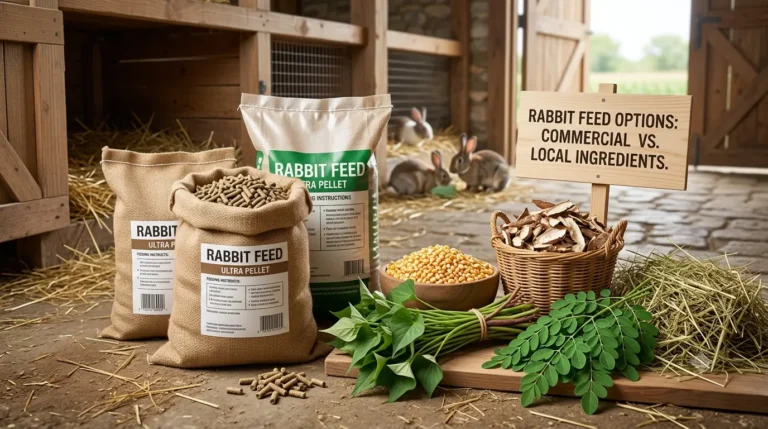
Farmers who rely entirely on commercial pellets face higher costs but often see faster, more predictable growth. Those who supplement with locally available forage — Moringa, sweet potato vines, Calliandra, or kitchen scraps — can cut feed costs substantially, though this requires more labor and careful balance to avoid nutritional gaps.
Other ongoing costs include basic veterinary supplies and preventive treatments, electricity or water if applicable, and labor, though many small operations run on family labor in the early stages, which keeps cash costs down.
Revenue Streams Beyond Meat
Meat sales are the obvious revenue source, but experienced farmers often diversify income in ways that significantly improve overall profitability:
- Live breeding stock sales: Selling young, healthy rabbits to other farmers starting out often commands a premium over meat prices.
- Rabbit manure: Highly valued by organic gardeners and crop farmers as a nutrient-rich fertilizer, and it requires no extra production effort.
- Pelts and fur: Particularly from breeds like the Chinchilla, though this market is more niche and location-dependent.
- Urine as bio-pesticide: Increasingly used in organic farming circles as a natural pest deterrent, sold to nearby crop farmers.
Farmers who treat manure and live stock sales as legitimate revenue lines, rather than afterthoughts, often see noticeably better overall margins than those relying on meat sales alone.
The Breeding Math That Drives Profit
Understanding the basic breeding math helps explain why rabbit farming can scale profitability quickly once established. A single healthy doe, bred efficiently, can produce 4–6 litters annually. With an average litter size of 7–8 kits and reasonable survival rates, that’s potentially 30–40+ rabbits per doe per year.
If even a modest portion of those reach market weight and sell at a reasonable price, the income generated from just a handful of breeding does can be substantial relative to the feed and housing costs involved. This is the core economic engine that makes rabbit farming attractive — high reproductive output relative to the space and capital required.
The catch is that this math only works with consistent management. Poor breeding records, inconsistent feeding, or disease outbreaks can quickly erode what looks like strong potential profitability on paper.
A Sample Small-Scale Budget
While exact figures vary widely by country, region, and currency, here’s a simplified illustration of how a small operation’s economics might break down over a year, using relative proportions rather than fixed amounts:
- Feed costs: Roughly 60–65% of total expenses
- Housing maintenance and equipment: Around 10–15%
- Veterinary and preventive care: Around 5–10%
- Miscellaneous (transport, marketing, labor): Remaining 10–15%
Against these costs, revenue from meat sales, breeding stock, and manure typically allows well-managed small operations to see healthy margins once the initial breeding herd is established and producing consistently, often within the first year of disciplined operation.
Factors That Make or Break Profitability
Profitability isn’t guaranteed just by raising rabbits — it depends heavily on how the operation is run. Key factors include:
- Mortality rates: High kit mortality from disease or poor housing directly erodes profit margins.
- Feed efficiency: Wasted feed or poor-quality feed slows growth and increases costs per kilogram of meat produced.
- Breeding consistency: Irregular breeding cycles mean inconsistent supply, which makes it harder to build reliable buyer relationships.
- Market proximity: Farms located near urban centers or restaurants typically command better prices than those far from buyers.
- Record-keeping: Farmers who track costs, litter sizes, and growth rates can identify and fix inefficiencies far faster than those operating on guesswork.
Finding Reliable Markets
Production is only half the equation — having somewhere to consistently sell your rabbits matters just as much. Several market channels work well across different African contexts:
- Local restaurants and hotels: Particularly those marketing health-conscious or specialty menus.
- Community and church groups: Word-of-mouth sales within tight-knit communities often provide steady, reliable demand.
- Online and social media sales: Increasingly common, especially for live breeding stock sold to new farmers.
- Local markets and butcheries: Direct sales to consumers looking for affordable, lean protein options.
Building relationships with two or three reliable buyers before scaling production is far safer than producing first and hoping a market appears afterward.
When and How to Scale Up
Many farmers make the mistake of scaling too fast, adding dozens of breeding does before they’ve worked out feed logistics, market demand, or disease management at a smaller scale. A better approach is gradual: prove profitability with a small herd first, reinvest profits into housing and breeding stock, and only scale once your systems — feeding schedules, record-keeping, market relationships — are running smoothly.
Farmers who scale this way tend to avoid the cash flow crunches that come from sudden, large feed bills without a matching increase in reliable sales.
Common Mistakes That Hurt Profitability
- Starting too big, too fast, without testing market demand first.
- Underestimating feed costs, especially during dry seasons when forage is scarce.
- Neglecting record-keeping, making it impossible to identify which does or practices are actually profitable.
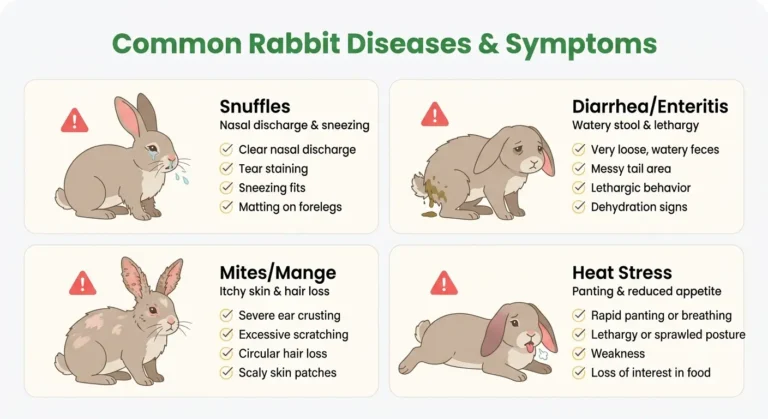
- Ignoring disease prevention, leading to costly outbreaks that wipe out months of progress.
- Relying on a single buyer, which leaves the business vulnerable if that relationship ends.
Frequently Asked Questions
How long does it take to become profitable in rabbit farming?
Most well-managed small operations start seeing consistent profit within 6–12 months, once the breeding herd reaches a stable production cycle.
How much capital is needed to start rabbit farming?
Startup costs can be kept relatively low by building basic housing with local materials and starting with just a few breeding pairs rather than a large herd.
Is rabbit meat in demand in African markets?
Demand is growing steadily, particularly among health-conscious consumers and in urban areas, though market development varies significantly by country and region.
What’s the biggest expense in rabbit farming?
Feed typically represents the largest ongoing cost, often 60% or more of total operating expenses.
Can rabbit farming be done alongside other income sources?
Yes, many successful rabbit farmers start part-time alongside other work or farming activities, scaling up gradually as the operation proves profitable.
Final Thoughts
Rabbit farming in Africa can absolutely be profitable, but the real returns go to farmers who approach it with discipline rather than just enthusiasm. That means realistic budgeting, consistent breeding management, diversified revenue streams, and patient, gradual scaling rather than rushing to grow too fast too soon.
For those willing to put in the early groundwork, the math genuinely works in rabbits’ favor — fast reproduction, low space requirements, and growing market demand make this one of the more accessible paths into profitable livestock farming on the continent today.