How to Start a Profitable Quail Farming Business in Africa (2026 Guide)
A few years ago, quail farming in Africa was something you’d find tucked away in a handful of backyards, mostly hobbyists keeping a few birds for eggs and curiosity. That’s changed fast. Across Nigeria, Kenya, Ghana, South Africa, and beyond, quail farming has quietly become one of the most accessible entry points into livestock business for people with small capital and limited land.
I’ve watched this shift happen in real time through farming communities and agricultural forums: a university graduate in Lagos starting with 50 birds in a spare room, a retired civil servant in Nairobi converting a backyard shed into a quail unit, a young couple in Accra selling quail eggs to local restaurants within three months of starting. None of them had massive capital. What they had was a clear plan and realistic expectations.
This guide walks through exactly what it takes to start quail farming as a real, profitable business in Africa in 2026, not just as a hobby, but as something that can genuinely support a household income.
Table of Contents
- Why Quail Farming Makes Sense for Africa Right Now
- Understanding the Market and Demand
- Startup Requirements and Initial Costs
- Housing and Equipment Setup
- Choosing the Right Breed and Sourcing Birds
- Feeding Program and Costs
- Daily Management and Care
- Revenue Streams: Eggs, Meat, and Breeding Stock
- Common Challenges and How to Avoid Them
- Scaling Up: From Side Hustle to Full Business
- Regulations and Local Requirements
- Frequently Asked Questions
Why Quail Farming Makes Sense for Africa Right Now
Quail farming has a few structural advantages that make it particularly well-suited to African markets in 2026. First, the space requirement is tiny compared to poultry or livestock. You can start a meaningful operation in a converted room, a backyard shed, or even a section of an apartment balcony in urban areas.
Second, quail mature fast. A hen can start laying eggs at 6 to 8 weeks old, which means your first revenue cycle is much shorter than chickens (16-20 weeks) or larger livestock. That speed matters enormously when you’re working with limited starting capital and need cash flow returning quickly.
Third, demand is genuinely rising. Quail eggs are increasingly marketed in West and East Africa as a nutrient-dense, premium alternative to chicken eggs, often positioned for health-conscious buyers, hospitality businesses, and traditional medicine markets where quail products carry cultural value.
Understanding the Market and Demand
Before buying a single bird, spend real time understanding who will actually buy from you. The African quail market generally breaks into these buyer groups:
- Individual households buying quail eggs for nutrition, often in batches of 10-30 eggs
- Restaurants and hotels using quail eggs and meat as a premium menu item
- Other farmers looking to buy breeding stock or day-old chicks to start their own operations
- Traditional health markets in regions where quail eggs are believed to have medicinal value
- Pet and exotic bird enthusiasts in urban centers
Practical tip: Before scaling production, sell to your immediate network first—family, neighbors, local market vendors. This gives you real feedback on pricing and demand without the risk of overproducing with nowhere to sell.
Startup Requirements and Initial Costs
One of the biggest reasons quail farming attracts new entrants is the relatively low barrier to entry. Here’s a realistic breakdown for a starter operation of around 100-150 birds:
- Day-old chicks or started birds: 100-150 birds at local market rates
- Housing/cage setup: Wire cages or a converted enclosed space with proper ventilation
- Feeders and waterers: Basic trough-style equipment, often locally fabricated
- Feed for first 6-8 weeks: Starter feed until birds reach laying age
- Lighting: Bulbs or a simple timer system for consistent daylight hours
- Miscellaneous: Bedding, basic vet supplies, record-keeping materials
Exact costs vary significantly by country and currency, but the overall investment for a small starter unit is dramatically lower than poultry or goat farming at similar scale. Many new farmers start with what they’d spend on a smartphone.
Housing and Equipment Setup
Quail don’t need elaborate housing, but they do need protection from predators, consistent ventilation, and protection from extreme heat, which matters a lot in many African climates.
Cage vs. Floor Systems
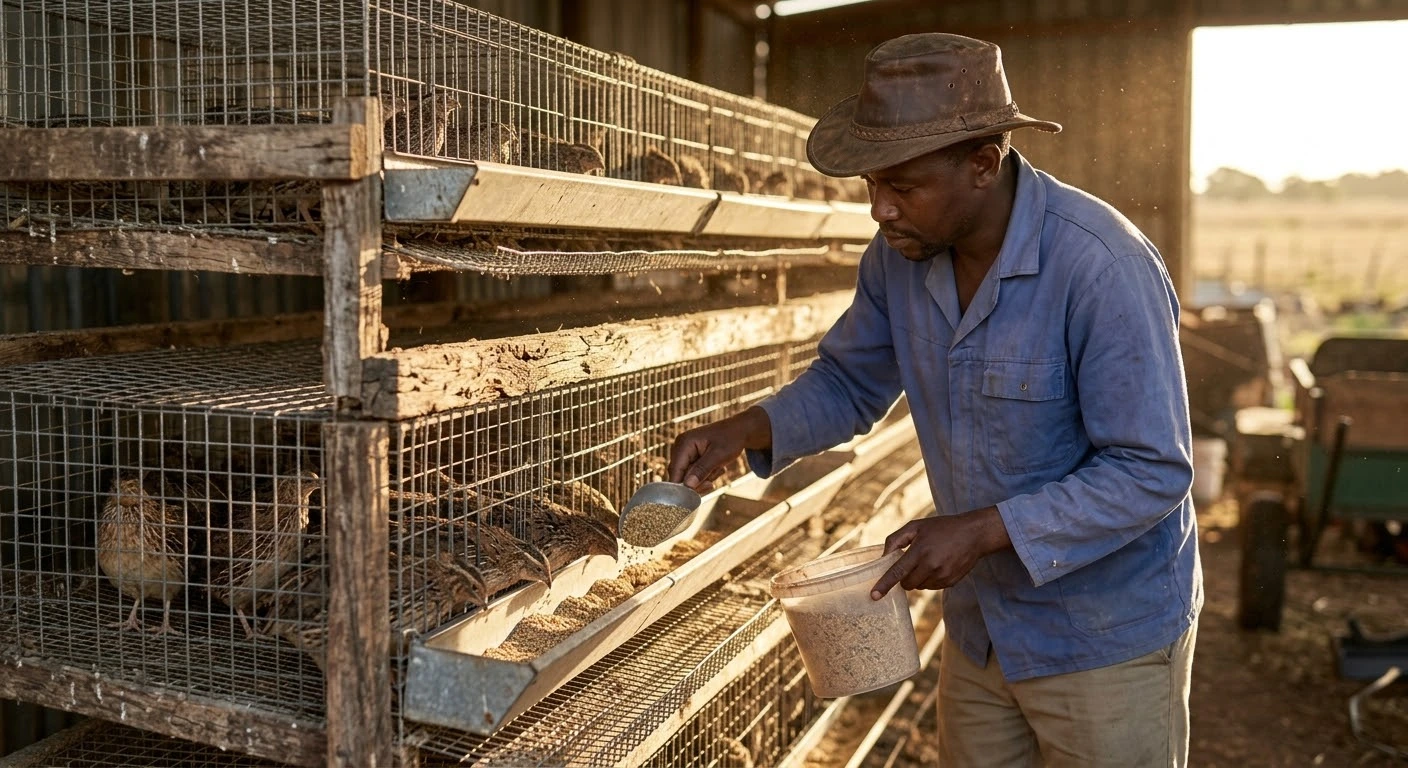
Most commercial-style operations use stacked wire cages, which maximize bird density per square meter and make egg collection and cleaning far easier. Floor systems with deep litter work too, especially for smaller hobby setups, but they require more floor space and more frequent cleaning to control ammonia buildup and disease risk.
Ventilation and Temperature
In hotter regions, shade cloth, open-sided structures, and good airflow are essential. Quail are sensitive to heat stress above roughly 30°C (86°F), and production drops sharply when birds overheat. In cooler highland areas, the priority shifts toward draft protection and insulation.
What to do: Visit an existing local farm if at all possible before building your own setup. Climate-specific adjustments make a real difference, and seeing a working system beats any written guide.
Choosing the Right Breed and Sourcing Birds
The Coturnix quail (Japanese quail) is by far the most widely raised breed across Africa, prized for its fast growth, strong egg production, and adaptability to varied climates. Within Coturnix, you’ll typically choose between:
- Egg-laying lines bred for high, consistent egg output
- Meat lines (Jumbo Coturnix) bred for larger body size and faster weight gain
- Dual-purpose stock for farmers wanting both eggs and meat revenue
Sourcing tip: Buy your starting stock from an established, reputable local breeder rather than an unknown online seller. Ask about the parent flock’s productivity, vaccination history, and any disease issues. A slightly higher price for healthy, verified stock pays for itself many times over compared to dealing with a weak or diseased starting flock.
Feeding Program and Costs
Feed is typically the single largest ongoing cost in quail farming, often 60-70% of total operating expenses. Getting this right directly determines your profit margin.
- Starter feed (0-3 weeks): High protein, around 24-28%
- Grower feed (3-6 weeks): Slightly reduced protein as birds mature
- Layer feed (6+ weeks): Balanced for sustained egg production, with added calcium
Many successful African quail farmers reduce costs by sourcing local feed ingredients (maize, soybean meal, fish meal) and mixing their own rations once they understand correct nutrient ratios, rather than relying entirely on commercial feed. This requires more knowledge upfront but can meaningfully improve margins at scale.
What to do: Start with commercial feed for your first cycle to establish a baseline. Once you understand your birds’ consumption patterns and have stable cash flow, explore local feed-mixing to cut costs.
Daily Management and Care
Quail are low-maintenance compared to most livestock, but consistency is everything. A realistic daily routine includes:
- Checking and refilling feed and water (twice daily in hot climates)
- Collecting eggs at consistent times to prevent damage or pecking
- Visual health checks for lethargy, unusual droppings, or respiratory signs
- Basic cage or bedding cleaning to control ammonia and disease risk
- Monitoring lighting hours, especially important for consistent laying
Real talk: The farmers who succeed are rarely the ones with the fanciest setups. They’re the ones who show up every single day without fail. Quail respond quickly to neglect, and a missed water refill on a hot afternoon can set your flock back for days.
Revenue Streams: Eggs, Meat, and Breeding Stock
One of quail farming’s biggest advantages is that you’re not locked into a single product. A well-run operation can generate income from multiple directions:
Egg Sales
The most consistent and immediate income stream. Quail eggs sell as fresh table eggs, often packaged in trays, and increasingly as a “premium” or “health” product commanding higher prices than standard chicken eggs.
Meat Sales
Quail meat is gaining traction in restaurants and among consumers looking for lean, alternative protein. Spent layer hens (past peak production) and dedicated meat-line birds can both be sold for meat, reducing waste from your operation.
Breeding Stock and Day-Old Chicks
As more people enter quail farming, selling fertile eggs, day-old chicks, or started birds to new farmers can become one of your most profitable lines, often at significantly higher margins than table eggs.
Pro tip: Don’t try to do all three from day one. Master egg production first, build a reliable customer base, then expand into meat and breeding stock as your confidence and systems mature.
Common Challenges and How to Avoid Them
- Heat stress: Invest in shade and ventilation early rather than reacting after losses
- Disease outbreaks: Maintain strict hygiene and quarantine new birds before introducing them to your flock
- Inconsistent feed quality: Build a relationship with a reliable feed supplier rather than constantly switching sources
- Market saturation in oversupplied areas: Research local competition before scaling production
- Predator losses: Secure housing against rodents, snakes, and birds of prey, which target quail aggressively
Most farming failures in this space come down to underestimating daily care requirements or scaling too fast before establishing solid demand. Slow, steady growth consistently beats rushing.
Scaling Up: From Side Hustle to Full Business
Once your starter flock is stable and profitable, scaling typically follows this pattern:
- Phase 1 (Months 1-3): 100-150 birds, focus on learning and establishing local customers
- Phase 2 (Months 4-8): Expand to 300-500 birds, introduce basic record-keeping and possibly a second income stream (meat or chicks)
- Phase 3 (Year 1+): 1,000+ birds, formalize the business with proper branding, packaging, and possibly wholesale relationships with restaurants or retailers
Reinvesting early profits into housing and equipment, rather than withdrawing them immediately, is what separates farmers who scale successfully from those who stay stuck at hobby size.
Regulations and Local Requirements
Requirements vary significantly by country, but generally include basic livestock business registration, and in some regions, veterinary or agricultural extension office approval, particularly once you’re selling commercially rather than just to neighbors.
What to do: Contact your local agricultural extension office before scaling beyond hobby size. Many offer free guidance, and in some countries, small grants or low-interest loans specifically for poultry and quail farming entrepreneurs.
Frequently Asked Questions
How much capital do I really need to start?
A small starter operation of 100-150 birds is achievable with modest capital, far less than poultry or goat farming at comparable scale. Exact figures depend heavily on your country and local supplier pricing.
How long until I see a profit?
With Coturnix quail laying at 6-8 weeks old, many farmers see their first egg revenue within two months of starting, though full profitability after covering startup costs typically takes 4-6 months.
Can I start quail farming in a small urban space?
Yes. Quail’s small footprint makes them one of the few livestock options realistically suited to urban backyards, balconies, or converted rooms.
Is quail farming more profitable than chicken farming?
Per bird, quail often generate faster returns due to quicker maturity and shorter production cycles, though individual egg and meat prices are lower than chicken. Profitability depends heavily on local market demand and pricing.
Final Thoughts
Quail farming isn’t a guaranteed overnight success story, but it is one of the most realistic, low-barrier paths into livestock entrepreneurship available across Africa right now. The combination of low space requirements, fast maturity, and multiple revenue streams makes it genuinely accessible to people without large capital or land.
If you’re serious about starting, begin small, learn the daily rhythms of caring for your flock, and build real relationships with local buyers before scaling. The farmers who succeed long-term are rarely the ones who started biggest. They’re the ones who started smart, stayed consistent, and grew at a pace their knowledge and cash flow could actually support.